Kolleen Lain, Age 65
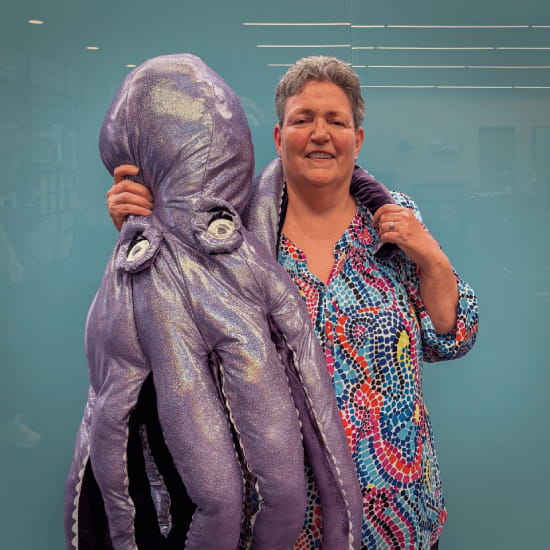


“You get your brain back through NeuroAnimation.”
Kolleen’s story is one of reconnection — to her movement, her clarity, and herself.
In December 2021, she was diagnosed with Parkinson’s Disease.
Over time, she began to feel the effects. Brain fog made it difficult to think clearly. Her left hand
lost coordination. Balance became more challenging, especially when turning. Her leg fatigued easily.
These changes didn’t just affect her physically — they began to impact how she lived. Social anxiety increased. Everyday tasks like slicing vegetables or folding clothes became more effortful.
She wanted something simple, but powerful:
- She wanted her brain back.
- That’s what led her to NeuroAnimation.
- And what followed was both measurable and deeply personal.
Throughout her program, Kolleen demonstrated clear improvements in mobility, coordination,
and cognition:
Timed Up and Go (TUG): 7.49 seconds
→ 0.30 second decrease (3.85% improvement), reflecting better walking speed, turning, and overall mobility
TUG-Cognitive: 7.44 seconds
→ 1.76 second decrease (19.1% improvement), showing stronger dual-tasking ability — thinking and moving simultaneously
Grip Strength (Dynamometer):
Right Hand: +6.6 lbs (10.8% improvement)
Left Hand: +4.8 lbs (9.34% improvement)
→ Demonstrating improved neuromuscular connection and control
Cognitive Assessment: 247 → 406 (64.4% improvement)
Including:
Processing Speed: +55.1%
Attention Span: +56.9%
Impulsivity Control: +88.4%
Executive Function & Memory (combined domains): improvements ranging from 43% to 72.9%
But the most meaningful changes were the ones she felt every day.
“My brain fog has diminished. I’m more focused, with clarity throughout the day. It happened gradually.”
“I can take small steps around the kitchen much easier — I don’t even notice it anymore.”
“Just a couple days ago, my left arm was swinging naturally. It hasn’t done that since I was diagnosed. I don’t have to force it anymore. It’s amazing.”
“My wife and other people have noticed that my face is brighter, my eyes are clearer — I truly am regaining my life.”
“I feel more like my old self… I’ve gotten parts of myself back. I don’t have to think about things as much anymore — it’s automatic, like how it used to be.”
These changes go beyond performance.
They reflect a shift back toward automaticity — where movement, thought, and action no longer require constant effort. Where daily life begins to feel natural again.
For Kolleen, this wasn’t just about improving symptoms.
It was about reclaiming the version of herself she knew was still there — and finally accessing it
again.