Marsha Taylor, Age 74
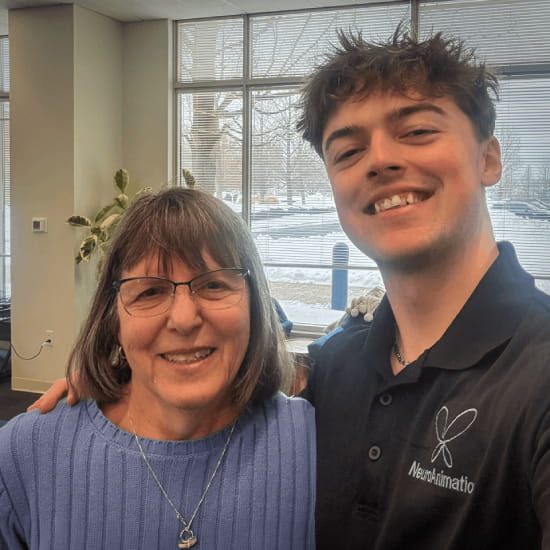



Marsha regained the ability to write clearly again, 14 years after a Parkinson’s diagnosis.
Marsha is an active, joyful, and strong-willed individual. But in 2014, she received a life-changing diagnosis: Parkinson’s Disease.
Over the years, the disease steadily progressed. Her toes began to curl. Tremors in her hands made writing difficult. Her memory felt less reliable, clouded by increasing brain fog. Despite doing everything she could — attending a Parkinson’s group twice a week, practicing Pilates, and staying active — she felt her world slowly narrowing.
She wanted more. She wanted to get back to the gym. Back to the routine that once made her feel strong, capable, and independent.
But the message she received from multiple doctors and neurologists was discouragingly consistent: her condition would continue to decline, and a wheelchair was likely in her future. There was little, if anything, to be done.
Then, by chance, she met Omar Ahmad on a plane.
He shared the NeuroAnimation approach with her — a different way of thinking about the brain
and recovery. It was enough for Marsha to take a chance.
She arrived with a positivity she never lost. Early in her program, her specialist gave her a
message that would come to define her experience: “Trust yourself.”
And that’s exactly what she did.
Throughout bootcamp, Marsha worked consistently, stayed engaged, and leaned into the
process. Over time, she began to see meaningful, measurable changes:
- Berg Balance Scale: 54/56 → 56/56, with improvements in single-leg stance and tandem stance
- TUG-Cognitive: 4.12 second decrease (11.8% improvement), reflecting stronger walking and dual-tasking ability
- Grip Strength (Dynamometer): +2.2 lbs (4.15% improvement), indicating increased neurological connection
- Cognitive Assessment: 255 → 351 (37.6% improvement), including a 55.3% improvement in working memory and a 21.2% improvement in short-term memory and executive function
But the most meaningful change for Marsha was something she could feel every day.
Her tremors — once constant and limiting — nearly disappeared. The shaking reduced significantly, and when it did return, it took much longer between medication cycles. For the first time in years, her hands felt steady.
She was able to write handwritten notes again — something she loved, and something that had slowly been taken from her.
Beyond the numbers, this is what changed everything.
Movements that once felt uncertain became controlled. Her confidence in walking improved. Her
mind felt sharper and more reliable. What once felt like inevitable decline began to open into
possibility.
For Marsha, this wasn’t just about managing Parkinson’s — it was about reclaiming ownership
over her body, her independence, and the parts of her life that mattered most.